

Projects
Researchers, interns and other students are regularly hosted on site doing various projects.
If you are interested in conducting work (biological, social, physical sciences or art-based projects) at the Nature Sanctuary, please:
- Complete and submit a Memorandum of Understanding and Research Waiver Form. Please follow the instructions in the form for completion and submission. Once your request has been received and reviewed, we will contact you.
- Once you have been approved to conduct research on-site, all permit protocols for fieldwork must be followed. If work is not being carried out aligned with site conservation and restoration goals, research may be halted.
- After research is complete, collected data and associated reports and findings must be made available to the Nature Sanctuary with three months of final work completion.
Here are some useful readings that provide ecological and cultural context:
- Swan Lake and Christmas Hill’s Management Plans
- History about the Nature Sanctuary, including Swan Lake Christmas Hill Nature Sanctuary From the Ground Up: A Brief Guide and History
- The Ecosystems
- Research and Restoration
- iNaturalist Project
Connect with us to learn more here: info [at] swanlake.bc.ca
Follow us @SwanLakeNature to see projects in action
Spring 2026 - Fall 2026 Projects:
Abby Hyde earned her Master's of Industrial Ecology through the Mitacs Accelerate program, a flagship program with an applied Research & Development focus. Abby's work represented a collaboration among Mitacs, University of Victoria, and Swan Lake Nature Sanctuary.
Her work titled, 'Relational Ecology in Urban Greenspaces: Creating a Design Tool for Biodiversity Programs and Events' [URL embedded] was inspired by a 2023 collaboration IISAAK Olam Foundation [URL embedded] to create an impact and accountability framework for reconciliation.
Abby's research at Swan Lake was conducted in two stages:
A. Four existing programs were audited using participant feedback through questionnaires and open conversations. These Swan Lake Nature Sanctuary programs represented an ideal case study for demonstrating the importance of nature-based programs and their impacts on participants.
B. Findings were synthesized with evidence from the literature on nature connectedness, relational ecology, and environmental education to develop a practical program design tool.
Analysis was based on:
- total values of answers to Likert scale questions (1-5 scale),
- absolute change between before and after responses,
- before and after responses partitioned by each program, and
- qualitative written responses.
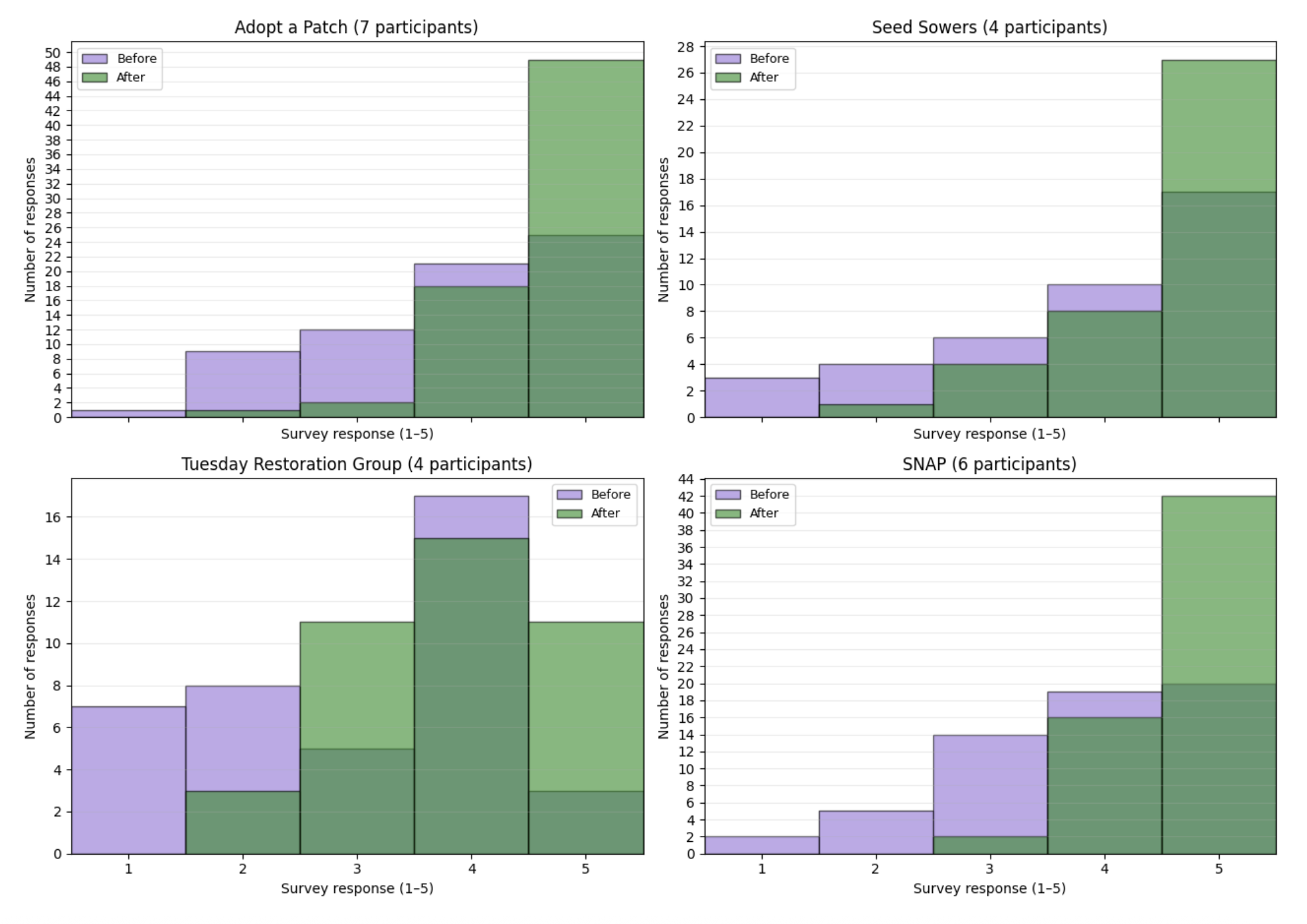
- Post-program distributions all showed a shift toward increased relationality and understanding of ecological systems.
- Designing programs that intentionally strengthen these relationships therefore represents a pathway for intervening in the "extinction of experience" phenomenon and can contribute to a sustainable future for this planet.
- People are not external users of our natural ecosystems, but instead active participants whose relationships with nature influence both environmental outcomes and societal resilience.
- If conservation organizations and municipalities can work together to help support these initiatives, the benefits of nature connectedness could be maximized, improving environmental, economic, and social well-being.
Read Abby's full report here [URL embedded].
Spring 2026 - Fall 2026 Projects continued:
Pure Water Engineering is conducting an oxygenation pilot project at Swan Lake to look at reversing the effects of cultural eutrophication. (Fall 2025 - present). Read more here [URL embedded].
Larissa (UVic Master's Student) is resurrecting past climate through a paleopalynology study. (Fall 2024 - present)
Spring 2025 - Fall 2025:
Emma (UVic Anthropology Student) conducted a research study, 'Preserving Ecosystems on Vancouver Island Through Volunteer Work: The Swan Lake Sanctuary.' (Fall 2025)
Maddy (UVic, Social Science 300 - Working in the Community) is creating biodiversity monitoring protocols and documentation for several species on site. (Spring 2025)
Kat (West Kootenay Rural Teacher Education Program) is completing their Community Field Experience placement on site. (Spring/Summer 2025)
Braedon created archival comparisons of photos to present day including some of Swan Lake. (Spring 2025)


Spring 2024 - Fall 2024:
Nat and Summer (Mindfulness, Sustainability, and Social Change). Ivy Project. (Fall 2024)
Acorn created an overview for increasing accessibility for neurodiversabilities at Swan Lake. (Fall 2024).
Sabrina Francescangeli's project "Community-Engaged Care for Rare, Threatened and Endangered Species in an Urban Nature Park" aimed to better understand how to get local community members more engaged in pro-environmental behaviours at urban nature parks like Swan Lake. Her review took into consideration conservation practices that other organizations have implemented in the past, with a specific focus on including equity-deserving groups. (UVic, Graduate Sustainability Scholars Program, Summer 2024)
Katie (Queen's University, Teaching Alternative Practicum). Environmental Education in Community. (Spring 2024)
Nat (UVic, Directed Studies). Endangered Species Habitat Restoration with a Community-Engaged Lens. (Spring 2024)
Darragh, Clara, Frankie, Magdalen and Cyrus (UVic, Geography). Christmas Hill Storymap. (Spring 2024)
Shayden (UVic, Directed Studies). Species Monitoring with a Community-Engaged Lens. (Spring 2024)
Brigitte & Michelyn (UVic, Social Science 300 – Working in the Community). Vermicomposting at the Nature House. (Spring 2024)


Fall 2022 - Spring 2023:
Mariah (UVic, Fine Arts) created a beautiful video about springtime at the Nature Sanctuary with Jay Rastogi. (Spring 2023)
Kristine (Global Field Program, Miami University, BIO 634: Issues in Evolution) put together a report on the Evolution Education with Threespine Stickleback at Swan Lake in B.C. that accompanied an infographic. (Spring 2023)
Pacific Rim Permaculture Students created draft designs for a possible garden site. (Fall 2022)
Sarah (UVic, Science Communication and Ecological Restoration course) wrote a communications plan for our nearest neighbours. (Fall 2022)
Kayla (Camosun, Practicum, in conjunction with Sanctuary Youth Centre) researched at-risk youth and substance users' barriers to participation in nature. (Fall 2022)
Sarah and Severine (UVic, Social Science 300 – Working in the Community) created a web map and content for our Nature House Native Plant Walk. (Fall 2022)
Spring 2021 - Summer 2022:
Inspire: STEM for Social Impact University of Victoria students determined a viable method to monitor the visitor traffic to our site. The monitoring system is able to use MAC address data to assess visitors in service of conserving and protecting Nature Sanctuary waters and lands. (Summer 2022)
Jake (UVic, Social Science 300 – Working in the Community) surveyed visitors and Sanctuary Nature Ambassadors Program (SNAP) volunteers to look at best ways to help promote the conservation bylaws (no dogs, no bicycles) on site. (Spring 2022)
Ruby researched the ethnoecological significance of Swan Lake, and the past and present histories that became the Nature Sanctuary. (Spring 2022)
Kai (UVic) archived and updated our photopoint monitoring program on Christmas Hill. (Fall 2021)
UVic Marketing students created marketing and communications plans to encourage more young people to get involved with the Nature Sanctuary. (Fall 2021)
Samara (UVic, Social Science 300 – Working in the Community) created curriculum content to help expand community awareness into Garry Oak Ecosystems. (Fall 2021)
Mekenzie (UVic) designed a community mapping project to look at the ways visitors explore the Nature Sanctuary and an infographic to help frame how to reconnect to nature. (Summer 2021)
Kireni (McGill) co-authored a Newcomer Grab & Go Nature booklet, assisted with site work and wrote a song. (Summer 2021)
Tomas (UVic) assessed how to improve the ecological function of a stream and wetland site at the Nature Sanctuary. (Spring 2021)


Help us monitor Western Painted Turtles on site!
If you have spotted a Western Painted Turtle in the Swan Lake Christmas Hill Nature Sanctuary grounds and surrounding area, please use this survey [URL embedded] to help us get a better idea of their population size and their behaviors. This will help us with moving towards obtaining Key Biodiversity Area (KBA) designation for Swan Lake and continuing to protect and conserve this rare species.